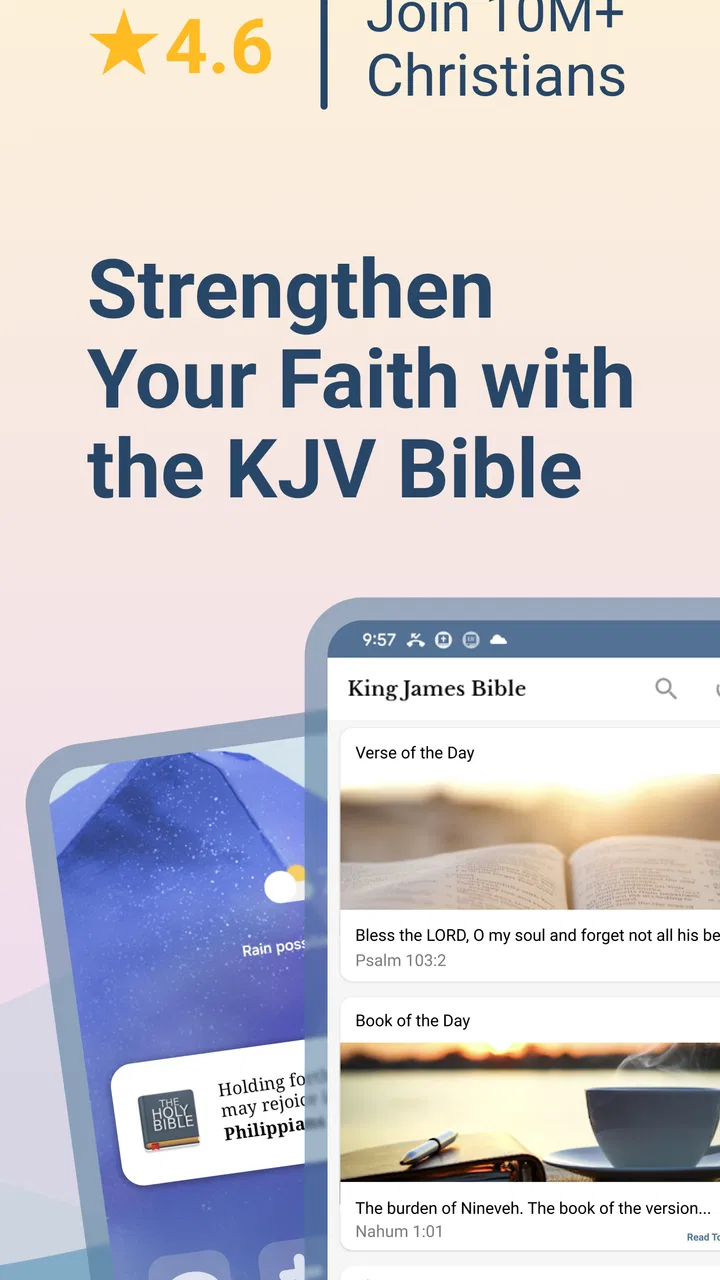
King James Bible Study KJV
- 4.6
- Rating
- 10.00M
- Installs
- Free
- Price

 Analysis by App-foxy
I usually approach Bible apps with one simple question: will I actually return to this one when I have a few quiet minutes, or will it become another icon I forget? After spending time with King James Bible Study KJV, I found its strongest case is straightforward: it puts the King James Version, audio reading, daily verses, and devotional material in one free reading space. That makes it especially appealing if the KJV is already the translation you trust and you want a routine rather than a large library of unrelated study tools.
This is a Books & Reference app from Salem Media Group, and it has been available since June 4, 2013. It is free to install, suitable for Everyone, and works on Android 8.0 or later. The current release is version 5.7.18. The app has reached over 10 million installs, with a 4.6 average from around 330 thousand ratings and about 58 thousand written reviews. Those figures suggest a mature, widely used app, although popularity alone does not guarantee that its reading style will suit you.
How I Decided Whether It Was the Right Bible App
My first decision criterion was translation loyalty. Many Bible apps are built around comparison, offering several translations, study notes, original-language tools, and extensive cross-referencing. That can be useful, but it can also make a simple reading session feel like research. This app is more focused. If your goal is specifically to read or hear the King James Bible, its narrower identity is an advantage rather than a weakness.
You May Also Like

 AccuWeather: Weather Radar
AccuWeather Review: A Quick, Clear Forecast for Everyday Decisions
For everyday plans, the best forecast is the one you can understand quickly. AccuWeather makes rain timing, radar, and local conditions easy to act on, with a few trade-offs.

 Hill Climb Racing
Why Hill Climb Racing Still Turns Crashes Into One More Run
A tiny car, a bumpy hill and one more upgrade: Hill Climb Racing keeps resurfacing because its simple chaos makes every near-miss feel personal.

 AliExpress - Shopping App
AliExpress Makes Global Shopping Feel Personal, but Shoppers Bear the Risk
AliExpress turns a global marketplace into a pocket-sized discovery engine. Its reach is useful, its shopping loop compelling, and its trade-offs easy to miss.

 Lords Mobile: Kingdom Wars
Lords Mobile Is a Kingdom-Building Routine, Not a Quick Match
A case-by-case verdict on the building, battles, device demands, and social commitments that make Lords Mobile rewarding for some players and exhausting for others.

 PDF Scanner app - TapScanner
TapScanner Makes Paperwork Easier to Capture, Check, and Share
TapScanner makes scanning with a phone feel less like a rescue operation and more like a dependable step in getting work done. Its capture tools are useful, though not flawless.

 Block Blast!
 Shows How Much a Puzzle Game Can Leave Out
A quiet grid game shows why puzzle players increasingly value instant clarity, repeatable skill and low-pressure play—and where the genre still needs to catch up.
More From Our News Desk
View All News


The second criterion was how easily the app supports different moments in the day. I tested its appeal from the perspective of someone who might read a chapter at home, listen while doing routine work, or open a short devotional during a break. The combination of text, KJV audio, daily verses, and devotionals gives it more flexibility than a plain digital Bible, without turning the experience into a complicated study dashboard.
I also considered how much friction appears between opening the app and beginning to read. A good Bible app should not make a person hunt through menus every time. Here, the central experience is recognizable quickly: choose the biblical book and passage when you want structured reading, or use the shorter daily material when you only have a minute. That distinction matters because a daily habit often fails through small inconveniences rather than a lack of interest.
Finally, I looked at whether the app makes sense for different kinds of readers. Someone seeking the exact wording and cadence of the KJV has a clear reason to try it. Someone wanting scholarly annotations, multiple translations side by side, or an extensive church-study platform may need to compare it with a broader alternative before moving over completely.
The KJV focus keeps the main experience uncluttered
The most convincing part of the app is its commitment to one familiar translation. The King James Version has a distinctive rhythm, and that rhythm is important to many readers for worship, memorization, personal devotion, or familiarity with traditional wording. I appreciate that the app does not force me to begin by choosing among a long list of translations when I already know which text I want.
That focus also makes the app easier to recommend to a family member who is not especially comfortable with technology. A person who wants “the King James Bible on the phone” is less likely to feel lost in a focused KJV reader than in a platform designed for advanced comparison. The age rating of Everyone reinforces its broad accessibility, although individual comfort with the older language will still vary.
There is a trade-off here. The KJV’s formal language can slow down a new reader, particularly in books with dense sentence structure or unfamiliar names. The app gives you access to the text, but it cannot remove the translation’s historical style. I would therefore suggest pairing reading with the devotional material or another trusted explanation if you are encountering the KJV for the first time.
Audio changes how the app fits into ordinary routines
The audio Bible is more than a decorative extra. I found it useful in situations where looking at a screen was inconvenient: during a quiet walk, while preparing a meal, or when I wanted to listen without turning reading into another visual task. Hearing the KJV can also make its cadence easier to follow, especially for passages that feel demanding when read silently.
My practical tip is to use audio as a second pass rather than automatically replacing reading. I might read a chapter first to notice names and structure, then listen later to absorb the flow. For a shorter session, I would do the opposite: start with audio, pause when a verse catches my attention, and return to the text. This two-mode approach gives the same passage different kinds of attention.
Audio is not ideal for every situation. If you need to locate a specific phrase, compare nearby verses, or take careful notes, text remains faster. Listening can also become passive if it is used only as background noise. I would treat the audio feature as a way to make Scripture more available during the day, not as a complete replacement for focused reading.
Daily verses and devotionals help create a repeatable habit
The daily content is the feature I would use most when I am trying to maintain consistency. A full chapter can feel like a commitment on a busy morning, while a daily verse gives me a smaller entry point. The devotional element adds context and reflection, so the app is not limited to opening a random passage and closing it again.
One useful workflow is to connect the daily material to a larger reading plan of your own. I can begin with the verse and devotional, then continue into the surrounding chapter instead of treating the selected verse as an isolated quotation. That approach avoids a common problem with short inspirational content: remembering a sentence while missing the argument or story around it.
I would also use the daily verse as a prompt for journaling or conversation rather than assuming it has answered every question. A short devotional is naturally selective. It can encourage reflection, but anyone studying doctrine, history, or a difficult passage should read more broadly and consult reliable resources. This is one of the app’s boundaries, not a flaw in the idea of daily content.
What feels smooth and what requires patience
The app’s focused purpose makes it approachable, but a focused purpose can also feel limited after the first few sessions. I did not choose it for a large research environment; I chose it for accessible KJV reading and listening. That distinction is important when setting expectations. If I want a quiet devotional tool, its simplicity helps. If I want to build a detailed cross-reference system, I would likely look elsewhere.
Another point to consider is the difference between free access and the complete ownership experience. The app is free, but it includes optional in-app purchases priced from $1.99 to $5.99 per item. That does not make the basic download a poor value, yet I would still check which optional additions matter to my routine before paying. A feature is worth buying only if it removes a real obstacle, not simply because it is available.
For a new user, I recommend spending several days with the free experience before deciding whether any purchase is useful. Try a morning reading, an audio session, and the daily devotional. If those three habits already cover what you need, there may be no reason to spend more. If an optional item supports a repeated workflow, then the cost becomes easier to judge against actual use rather than curiosity.
How it compares with broader Bible apps
The usual alternative in this category is a multi-translation Bible platform. Those apps are better when I need to compare wording, consult a wide range of study material, or move between devotional reading and deeper research. They can also be a better fit for group study when different people prefer different translations.
King James Bible Study KJV wins when the choice has already been made: I want the KJV and do not want translation selection to dominate the experience. Its audio and devotional focus gives it a more personal, routine-oriented feel than a reference library. In that sense, it is closer to a daily companion than a full digital study shelf.
A second alternative is a dedicated audiobook or audio-focused app. That kind of app may suit someone who listens almost exclusively and wants a broader spoken-content library. This KJV app makes more sense when audio needs to sit beside readable Scripture and daily devotional material. I would not switch to it solely for audio if I never plan to use the text or devotional features.
A third alternative is a printed KJV Bible. Paper remains excellent for long, uninterrupted reading, easy visual orientation, and a screen-free environment. The app wins on portability and listening, especially when carrying a physical Bible is inconvenient. It does not eliminate the value of print; it gives me another way to keep the same translation close during ordinary activities.
What switching would involve
Moving from a printed Bible to this app is easy in one sense: the text is always with the phone, and audio adds a new way to engage with familiar passages. The adjustment is learning to read without the physical landmarks of paper. I may need a little time to remember where books and chapters sit in the interface, especially if I am accustomed to turning pages quickly.
Switching from another digital Bible app has a different cost. If I already rely on extensive notes, multiple translations, or a carefully organized study workflow, a KJV-focused app may not replace everything. I would keep the broader app if research is central to my use, and add this one only if its KJV audio or devotional routine offers something genuinely better for me.
My advice is to switch gradually rather than deleting an existing app immediately. Use this one for a defined task, such as morning KJV reading or evening audio, for a week. Notice whether you open it naturally and whether the focused design feels refreshing or restrictive. That short trial reveals more than comparing feature lists because the real question is not how many tools an app contains, but which tools I actually use.
Who will get the most from it
I think this app is a strong match for readers who already prefer the King James Version, want a free starting point, and value a combination of reading, listening, and short devotional material. It is also suitable for someone returning to a Bible routine after a long break. The daily verse lowers the barrier to starting, while the full text is there when more time becomes available.
It can work well for households with different schedules too. One person might read directly from the screen, another might listen to the audio, and both can stay with the same translation. That shared consistency is useful when a family or small group wants to discuss familiar passages without first sorting out translation differences.
I would be more cautious recommending it to a reader who is new to the Bible and wants plain modern language, extensive explanations, or a guided academic study path. The KJV’s style may require patience, and the app’s focused design is not intended to be every kind of reference tool at once. In that situation, a clearer modern translation or a study-oriented alternative may be the better first choice.
My recommendation after using it
The best reason to choose this app is consistency with the KJV, not sheer feature quantity. It gives me a practical way to read the traditional text, hear it aloud, and return through daily verses and devotionals. I especially like it for short routines that need to survive busy days: a verse before work, audio during a walk, or a chapter before bed.
I would not present it as a universal replacement for every Bible resource. Readers who need multiple translations, serious annotation, or broad scholarly reference material should keep looking at larger study platforms. Readers who prefer paper and never listen to audio may gain little from changing their current setup. The app is most convincing when its focused KJV identity matches the way you already want to read.
For me, the final decision is favorable because the free entry point makes experimentation easy, the interface concept is clear, and the mix of text, audio, and devotional material supports more than one kind of day. The optional purchases deserve a deliberate decision rather than an automatic one, but they do not undermine the basic appeal. If you want a dedicated KJV companion for Android or iOS and value a simple daily rhythm over a large research toolkit, I would recommend giving it a genuine week of use.
FAQs for King James Bible Study KJV
01What is King James Bible Study KJV, and what can I do with it?
King James Bible Study KJV is a Bible-reading and study app centered on the classic King James Version translation. After installing it, users can read books and chapters, search for specific verses or words, bookmark meaningful passages, and often organize personal notes or highlights. It is designed for daily devotion, personal study, sermon preparation, and convenient Scripture reading when carrying a printed Bible is not practical.
02Does King James Bible Study KJV work without an internet connection?
Many users choose this type of Bible app because Scripture can usually be accessed offline after the required content has been installed. Offline availability may depend on the app version, downloaded resources, and certain additional features. Basic reading and saved passages are generally the most reliable without internet access, while advertisements, synchronization, sharing services, or other online tools may require a connection.
03Is the app completely free to download and use?
King James Bible Study KJV can generally be downloaded at no initial cost, but the exact business model may vary depending on the Android or iOS version. Some editions may include advertising, optional purchases, or premium features. Before installing, users should review the store listing for subscription details, in-app purchases, and privacy information so they understand which tools are available free of charge and which may require payment.
04What study tools are included in King James Bible Study KJV?
The main benefit is convenient access to the King James Bible, but the available study tools can differ between releases. Common features include verse and keyword search, bookmarks, history, highlights, notes, adjustable text size, and sharing options. Some versions may also provide daily reading features, devotionals, cross-references, or audio support. Check the current app description because not every edition includes the same resources.
05Is King James Bible Study KJV suitable for beginners and experienced Bible readers?
Yes, the app can be useful for both new readers and people who already study Scripture regularly. Beginners can navigate the Bible digitally, search unfamiliar passages, and create a simple reading routine, while experienced users may appreciate bookmarks, notes, and quick verse access. However, the King James Version uses older English, so newcomers may occasionally need a modern translation or study resource for additional clarity and context.
Pros
- Includes the complete King James Version Bible for offline reading.
- Strong search tools help locate verses
- words
- and passages quickly.
- Study notes and cross-references add useful historical and biblical context.
- Bookmarks
- highlights
- and notes make personal study easier to organize.
- Audio Bible support can be helpful for listening during commutes or quiet time.
Cons
- The KJV’s older English vocabulary may be difficult for new readers.
- Some study resources or features may require in-app purchases.
- Audio downloads can use considerable storage space on your device.
- Interface quality and navigation may vary between different app versions.
- Ads may interrupt reading for users on the free version.

King James Bible Study KJV
Gallery